
So, you’re considering telecom expense management services (TEM). And we understand why. Odds are it’s on your radar because you’ve got:
Multiple telecom service providers, contracts, and bills, and no unified view
Telecom invoices that don’t match usage, but nobody has time to chase down errors
Suspicions that there’s waste, but you need proof and a path forward
Too many spreadsheets and static portals to manage comfortably anymore
In short, you need a better way to manage your telecom services, and you’re wondering if investing in telecom expense management can help.
This guide was designed to help you figure that out. We’ve broken down what TEM really means and how it can actually solve these problems, not just report on them.
What You’ll Learn
What telecom expense management services actually include (and what they don’t)
What to expect from a good TEM partner and how the core services work
Whether outsourcing TEM makes sense for your business
How to evaluate vendors and spot red flags early
Where Ten4 fits in as an enterprise-ready TEM partner
Here we go.
Let’s Start with the Basics: What is Telecom Expense Management?

At its core, telecom expense management is the process of tracking, controlling, and optimizing your telecom assets and how much you’re spending on them. This includes things like:
Mobile plans,
Internet circuits,
Cloud voice services,
Unified communications tools, and
Any other service that keeps your teams connected.
Most big companies use dozens (even hundreds) of these services across multiple locations and carriers. Keeping it all straight? That’s a full-time job.
However, the right TEM services can take that job off your plate by pulling all the chaos into one clear, organized system you can actually manage.
Before getting into the specific service areas, though, here’s a quick reality check.
What TEM Is and What TEM Isn’t.
There’s a bit of confusion around what telecom expense management actually includes and what it doesn’t. So, here’s a quick reality check to keep things simple.
Telecom expense management is:
A centralized way to track your telecom spend. Instead of digging through portals, bills, and spreadsheets for all your cost allocations, TEM gives you one view of everything.
A system for finding and fixing billing errors. Think automated telecom audits, not guesswork.
A living inventory of existing services and assets. You’ll finally know what lines, licenses, and circuits you actually have (and which ones you don’t need anymore).
A tool for identifying waste and optimizing contracts. You’ll stop overpaying for misaligned or unused services.
A governance layer. It connects IT, finance, and procurement so everyone’s working from the same data.
What TEM Isn’t
TEM is not:
❌ Just a spreadsheet with all your contracts
❌ A once-a-year cost-cutting project
❌ A single carrier’s billing portal
❌ A reporting tool that tells you where you spent (but not what to fix)
❌ A DIY guessing game that burns your team’s time
Now that the definition is clear, here’s the part most buyers actually care about: what shows up in the day-to-day.
The 5 Pillars of Enterprise TEM Services (and Why They Matter)

If you’ve ever wondered, “What exactly am I getting when I sign up for a TEM service?” here’s your answer.
1. Invoice Processing & Normalization
This is where all your telecom bills (across every carrier, region, and service) get pulled into one place and translated into a common language. Doesn’t matter if one provider sends you a PDF, another gives you a portal, and another still faxes a bill (hey, it happens).
TEM systems take all those mismatched formats and turn them into clean, consistent data.
Why it helps: You can’t manage what you can’t compare. If each bill is formatted differently, how do you know what you’re really paying across vendors? Normalization gives you a clean, side-by-side view of your spend. It’s what makes everything else possible. Without it, you’re stuck reacting to billing surprises every month.
2. Audit & Dispute Management
Once your data’s cleaned up, it’s time to look for problems. Trust us, there are always problems. TEM tools are built to catch the stuff that slips past your AP team, like:
Charges for a phone line that was supposed to be canceled.
Taxes you shouldn’t be paying.
A telecommunications service you never ordered.
Once those mistakes are flagged, the TEM provider doesn’t just leave you hanging (at least not if it’s Ten4)! They handle the dispute process with the carrier and make sure you get the credit.
Why it helps: This is where real money starts coming back into the business. Most companies are overcharged (sometimes by 10–30 percent) and never know it. With dispute management built in, overpayments get identified and fixed automatically, and your team can stay focused on, well. . .their actual jobs.
3. Inventory & Asset Tracking
Here’s where things start to get really useful. Most companies don’t have a complete picture of what services they’re actually using. There are circuits billing at empty offices, mobile lines still active under someone who left two years ago, and licenses no one’s touched since the free trial ended.
TEM builds a live inventory of your entire telecom environment. We’re talking about every service, asset, and mobile device. You’ll know what’s active, where it is, who owns it, when it’s due for renewal, and how much it’s costing you.
Why it helps: It’s easy to lose track of services over time, especially when people change roles or offices. That’s how you end up paying for things no one uses anymore. A clean inventory helps unearth cost-saving opportunities while giving your team real visibility.

4. Optimization Services & Lifecycle Management
Now that you know what you have, you can start making better choices.
TEM services take that inventory and usage data and look for places to optimize and save. That might mean downgrading mobile plans that are way too generous. Or dropping licenses that haven’t been used in months. Or catching an overpriced service before it auto-renews at a higher rate.
Lifecycle management also keeps you ahead of deadlines. You’ll have visibility into when services are about to hit their renewal dates, which contracts are expiring, and where new needs are coming down the line.
Why it helps: TEM isn’t just about cutting telecom costs once. It helps you stop waste from creeping back in. Whether it’s right-sizing a mobile plan or managing a carrier renewal before the rates spike, you’ll stop reacting to telecom issues and start staying ahead of them. It also makes renewals way less painful.
5. Governance & Reporting
Once everything’s organized and optimized, you still need a way to keep things running smoothly. That’s where governance and reporting come in.
A good TEM platform gives different teams access to the data they care about. Finance teams can pull cost reports. IT can track usage. Procurement can see what’s up for renewal next quarter. You can even set rules and workflows so nothing falls through the cracks.
Why it helps: If everyone’s working from different spreadsheets, things get missed. Governance keeps your teams aligned, finance sees where the budget’s going, IT sees what’s in use, and procurement sees what’s coming up for renewal. It’s the glue that holds the whole TEM program together.
Now that we’ve unpacked what TEM actually looks like, let’s talk about who should be managing it: your internal team, or an outside partner?
In-House vs. Outsourced TEM: What’s the Better Move?
It honestly depends on your needs. Some enterprises want to keep everything in-house (and have the resources to do so). Others are ready to hand off the complexity.
If you’re somewhere in the “in-between” and aren’t sure which you’ll need, here’s a quick comparison chart to help you decide:
In-House TEM | Outsourced TEM |
|---|---|
✅ Full control over systems, processes, and data | ✅ Faster time to value with ready-made tools and experts |
✅ Can be cost-effective if you already have a mature telecom ops team | ✅ No need to build internal infrastructure or hire more staff |
✅ Keeps everything “in the family” | ✅ Access to telecom pros who know what to look for and where costs hide |
❌ Hard to scale across multiple carriers, regions, and services | ✅ Built to handle complexity — global carriers, mobile, cloud, you name it |
❌ Risk of knowledge loss if key team members leave | ✅ Ongoing support with processes and contract management |
❌ Requires deep telecom expertise (and people who actually have time) | ❌ Requires strong vendor management and clear expectations |
Bottom line: The key is finding the setup that gives you clarity and control without wearing your team out in the process.
If you’ve got the team, tools, and time, in-house can work. For most enterprises, though, outsourcing TEM gets you faster wins, cleaner data, and way less internal stress, especially when things start to scale.
Got questions about telecom expense management implementation? Check out our blog on the subject.
What to Look for in a TEM Provider

If outsourcing is on the table, the vendor choice matters a lot more than people expect. Here are the questions that separate a real TEM partner from a tool that just hands over reports and calls it a day.
How do they get your billing data? Look for automated ingestion from carrier APIs or portals, not just email uploads.
Do they normalize and audit all invoices? They should standardize bills across all vendors and audit every line item, not just a sample.
Will they manage disputes for you? Some providers just tell you what’s wrong. Others actually get it fixed.
Can they show you what you’re paying for? Inventory management is key. If they can’t build a clear telecom inventory, that’s a red flag.
Do they offer cost-saving recommendations? Ask to see examples of optimization reports and how those savings are tracked.
Are reports customizable and role-based? Your CFO and your network team don’t need the same view. Good platforms tailor reports to the user.
What kind of support do they offer? Do you get a dedicated contact? What happens when you need urgent help? If something goes sideways, fast, responsive support with a real point of contact keeps issues from snowballing into bigger (and costlier) problems.
Do they have real results to share? Ask about average recovery amounts, cost reductions, and client success stories. Real recovery numbers and client wins show they actually deliver, not just promise.
Even with a solid vendor list, a few common mistakes can quietly wreck the results. These are the ones that we see in the clients we’ve talked to.

4 Common Pitfalls to Watch Out For
Even with the best intentions, it’s easy to get tripped up when managing telecom expenses. Here are a few things to avoid:
1) Only looking at short-term savings.
It’s tempting to focus on the quick wins, like canceling a few unused lines. On the contrary, the biggest value often comes from long-term visibility and control.
2) Relying on carrier portals.
Carrier tools show you what they want you to see. They don’t compare across vendors, and they rarely flag billing mistakes.
3) Assuming all TEM providers are the same.
They’re not. Some focus on software, others on service details. Some only work with certain types of carriers. Ask detailed questions like the ones we’ve outlined above.
4) Trying to build your own tools.
Unless you’re a telecom company, building and maintaining your own TEM platform is usually more trouble than it’s worth.
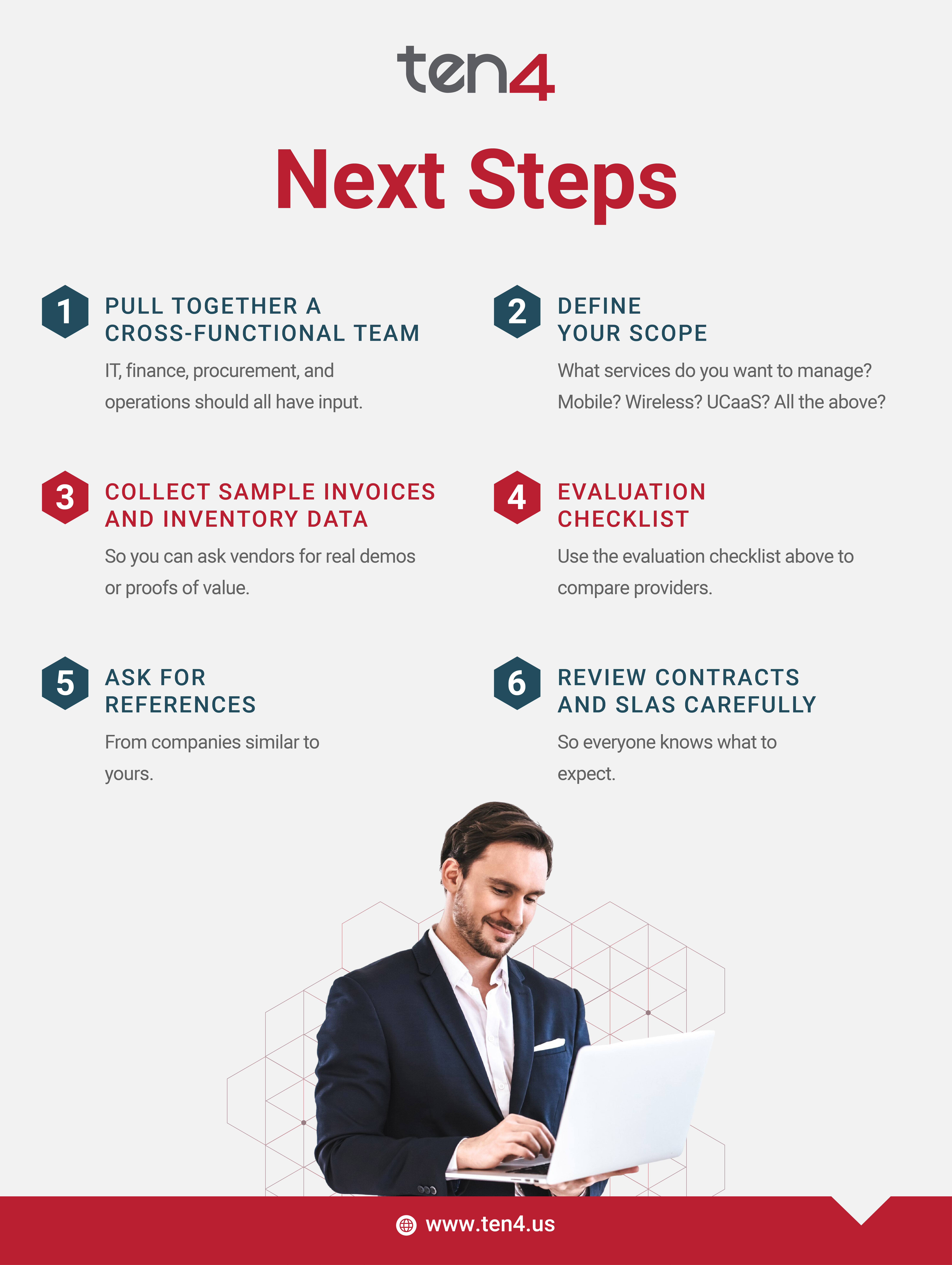
Now for the practical part: a simple graphic that will help you move forward in your telecom expense management journey.
What Ten4 Brings to the Table
If you’re trying to get a handle on telecom costs, our telecom expense management services at Ten4 are worth a look.
We built our platform to help enterprises:
Pull in all telecom spend across mobile, wireline, cloud, and UC
Find and fix billing errors
Track every asset and service in real time
Get hands-on expert support when and where you need it
And give finance, IT, and procurement teams the insight they need
Our team has helped companies recover six and seven-figure amounts in overcharges. Just as importantly, we’ve helped them stop overpaying in the first place.
We speak enterprise. We speak carrier. Plus, we love helping teams get control back.
Wrapping Up: TEM Is More Than Just Cutting Costs
Yes, telecom expense management services can save you money. Even more importantly, they give you clarity, control, and confidence in one of the most complex and fast-moving areas of your business.
That’s something spreadsheets will never deliver.
If you’re ready to get a handle on your telecom environment (and want a partner who’s seen it all), we at Ten4 can help assess your environment and walk through the next best steps.
Got questions? Our team’s happy to chat. Just reach out and let us know what you’re wrestling with.