It is a truth universally acknowledged that the more sites your company has, the messier your telecom cost management gets.
Because with each new site comes a new layer of complexity. Different sites often:
- Use different carriers
- Have their own point-of-contact managing services
- Get billed separately
- Operate on different contract terms
Pretty soon, nobody’s sure what’s live, what’s canceled, or who’s supposed to be watching it all. After all, the bigger your footprint grows, the harder it gets to stay on top of it all. . .
Unless you’ve got a system. That’s what this guide is here to give you: a clear, repeatable strategy for managing telecom spend across locations before the bloat bleeds you dry.
Let’s get started.
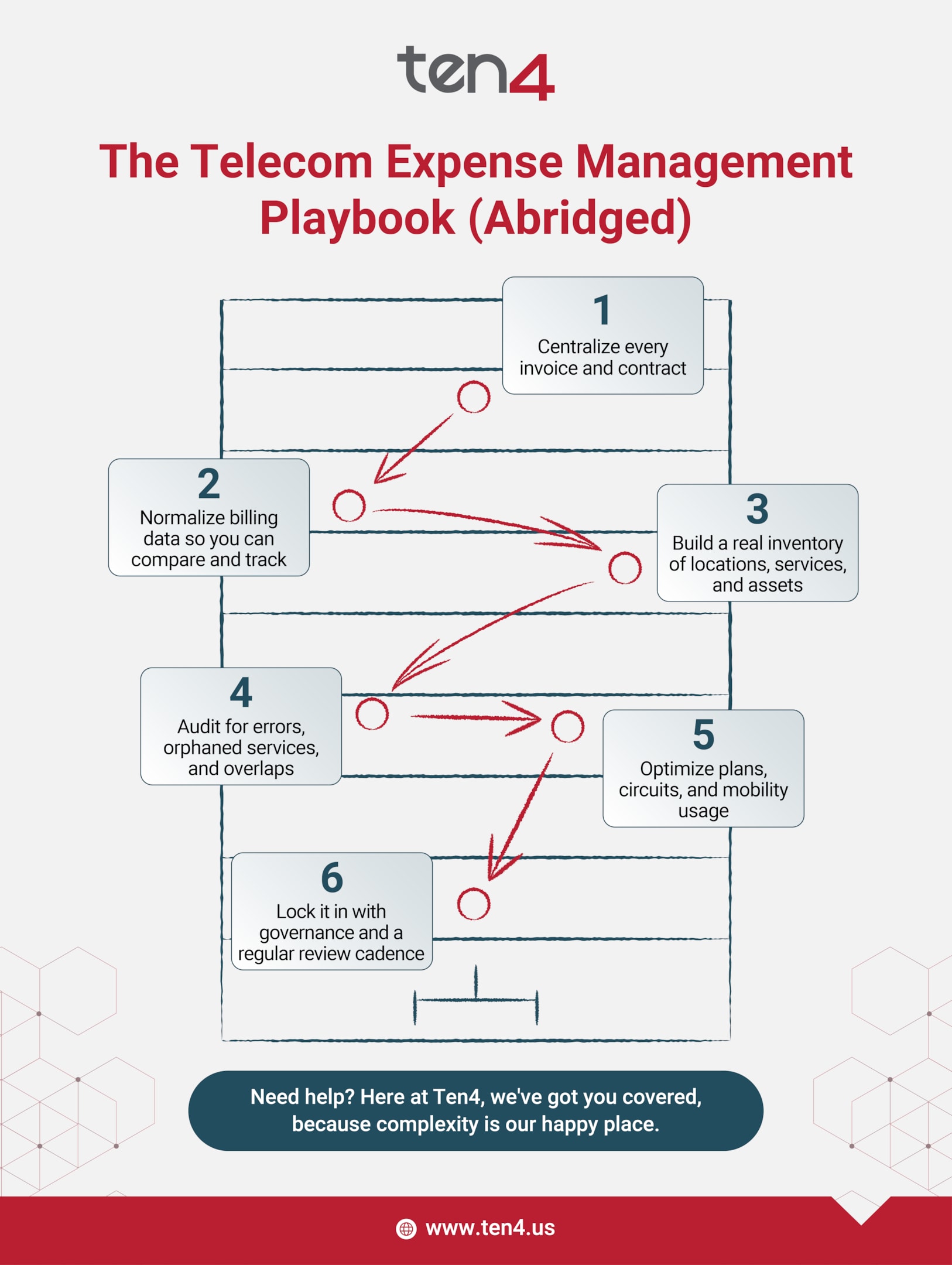
Step 1: Get All Your Invoices and Contracts in One Place

This is the first (and most important) step. Because if you can’t see everything you’re paying for, there’s no way to manage it.
For most multi-location businesses, telecom invoices are scattered across locations. They’re sent to individual store managers, buried in old email accounts, or still arriving as paper bills. The same goes for contracts. You might have them in folders, inboxes, or sitting on someone’s hard drive from three years ago.
What you need to do is centralize it all. Here’s how:
- Ask every location to send in copies of recent telecom invoices
- Collect every contract you can from all sites (even older ones)
- Create a shared inbox (like telecom@yourcompany[.]com) and direct all new invoices there
- Use a single system or folder structure to organize it all by site
If you work with a TEM (Telecom Expense Management) provider like us at Ten4, this is baked in. The platform pulls in invoices automatically, links them to contracts, and stores everything in one place making multi-location telecom management that much easier.
Quick Tip: Make this part of your onboarding and offboarding process for new sites. That way, nothing gets lost when opening or closing a location.
Once everything’s centralized, you’re ready to make sense of what you’re looking at.

Step 2: Standardize the Way You Read the Bills
Once your invoices are all in one place, you’ll probably notice something else: every carrier has its own way of formatting things. Some break out taxes line by line. Others use weird service codes. Some lump everything together.
Multiply that by dozens of locations and trying to compare costs from site-to-site stops being hard. It becomes almost impossible. This is why normalizing your data is so important.
Normalization just means converting every invoice into the same standard format so you can actually compare them. You’ll be able to:
- Compare costs across telecom service providers and sites
- Spot duplicate charges or strange fees
- Understand how your money is actually being spent
Most businesses can’t do this manually (and shouldn’t have to). That’s why many turn to TEM service platforms like ours at Ten4, which automatically handles all normalization and shows clear side-by-side comparisons.
Once the data’s normalized, it’s time to build a living inventory.
Step 3: Build a Real Inventory of Your Telecom Resources

Now that your data is easier to read, it’s time to ask a big question: What exactly are we paying for?
Most multi-location companies don’t have a clear answer to that. Some services were set up years ago. Others were moved or replaced, but the bills kept coming.
Inventorying your telecom services helps you figure out what you have, where it is, and what it’s supposed to do. Your inventory should include:
- Every internet circuit (and where it lives)
- Every phone line, mobile device, and plan
- What each service costs
- What location or team it belongs to
- Whether it’s active, pending disconnect, or no longer needed
If you’re using our telecom expense management software from Ten4, it can match services from invoices to physical locations, giving you a clean, dynamic inventory without dozens of spreadsheets required.
Once you can see these costs, the waste sticks out like a sore thumb. That means it’s easier to find (and dispose of).
Curious about what telecom expense management software is and how it works? Check out our guide on the subject.
Step 4: Audit for Errors, Orphaned Services, and Wrong Charges

Here’s where you start finding the money. Once you have a complete inventory and your billing is normalized, you can start running audits. The goal is simple: find stuff that shouldn’t be there.
That includes:
- Charges for locations that are closed
- Lines that were never disconnected
- Phones or hotspots no one’s using
- Contracts with pricing that doesn’t match what’s on the bill
- Taxes applied incorrectly based on location
Most internal teams don’t have the time to check every single line item. That’s why many companies use Ten4 and our TEM tools to automatically flag common issues and surface potential overcharges.
Real-Life Example: One nationwide company with 200+ locations thought they had telecom under control. . .until a full inventory revealed 900 old POTS lines still racking up charges. With our help, they matched every service to its location, flagged what was still in use, and cut the rest. The result? Over $900,000 in annual savings. That’s the power of an audit.
Once you know what’s wrong, you can dispute it, disconnect it, or renegotiate it, and start bringing your costs down fast. This brings us to step 5.
Step 5: Right-Size Plans and Services to Fit Each Location

Now that you’ve removed the junk, you’re left with services you actually need. However, there’s still one more thing to check: are they sized right for how your locations use them?
Maybe some stores are overpaying for high-speed internet they don’t need. Or maybe your mobile plan is based on old usage patterns. Or maybe your backup lines haven’t been tested in years.
Now’s the time to:
- Adjust bandwidth levels at each site
- Pool mobile data across regions
- Migrate to more cost-effective phone systems
- Drop services that are no longer useful
Here at Ten4, we help with this, too. Our telecom expense optimization tools recommend where to scale up or down, based on your actual usage and business goals.
Quick Tip: Benchmark your contracts annually. What made sense two years ago might be way off the mark now, especially given changing usage patterns post-2020.
Now that you’re lean and clean, how do you stay that way?
Step 6: Set a Cadence for Keeping Things Clean

By now, you’ve done the hard work: cleaned things up, gotten visibility, and optimized what you have.
Now you need a plan to keep it that way by establishing a telecom governance process. Basically, this is a repeatable rhythm for checking in on your telecom environment and holding someone accountable for it.
Here’s what your telecom cost management routine could look like:
- Every month: Look at usage reports to catch anything weird, like sudden drops or spikes
- Every quarter: Analyze spending with your finance team to spot any cost changes
- Before contracts renew: Get alerts so you have time to review or renegotiate
- Once a year: Review all your services to make sure they still match your business needs
Regularly reviewing your telecom assets helps you stay ahead of potential problems and ensure every location stays in budget and on track.
Quick Tip: Assign a single owner or team to telecom cost control. When it’s “everyone’s job,” it ends up being nobody’s.
We at Ten4 make governance easy with automated reports, dashboards, and alerts so you’re always one step ahead, not reacting after the fact.
How to Make Telecom Expense Management Easier
Our team at Ten4 has helped multi-location companies just like yours (retailers, healthcare providers, logistics firms) get their telecom costs under control.
With our Telecom Expense Management services, we help you:
- Bring all your billing and inventory into one place
- Spot and fix waste
- Simplify contracts and renewals
- Build an ongoing, repeatable process
Whether you’re managing 12 locations or 200, we’ve got your back.
So, ready to get a handle on your telecom spending?
If you’re juggling messy invoices, confusing contracts, and growing costs, it’s time for a better way. Reach out to us here at Ten4 and let’s build a cost management process that works for your business and sticks.