Telecom is one of the only recurring budget lines that can still jump-scare your accountant and CFO.
Why does this happen? Well, a discount quietly runs its course and expires. A site closes, or there’s staff turnover, but the circuit lives on like a zombie subscription. A carrier adds a fee with a name that sounds official enough to avoid questions and isn’t noticed for quite some time. Now, the forecast and budgeting season is here; the telecom numbers become the star of the show, and not in a good way.
That’s exactly where telecom spend management earns its keep.
When it’s done right, it creates visibility into your entire telecom expenditures, cleaner cost governance, and defensible expense reporting, so your forecast stops wobbling, and IT budget control stops feeling like wishful thinking. It can even be done without turning your finance team into part-time telecom detectives.
If you want the practical version of what this looks like in the real world, here at Ten4, we design telecom spend management that’s built for multi-location organizations needing predictable, auditable numbers. Let’s get into it.

Why traditional telecom costs are so hard to forecast
For years, telecom cost forecasting has felt harder than it should be. We can look back and see that after a while, diligent expense tracking falls off, and slowly but surely, prices start to change. Taking advantage of this culture of complacency has given the entire industry a black eye.
Overcoming this is why we at Ten4 have invested so much time and resources in developing our Billing Plus telecom expense management (TEM) solution. Below are concrete reasons you need to seriously consider what’s next.
1) Telecom spend is scattered across too many places
Multi-site organizations are often stretched thin and need to juggle:
- Multiple carriers by region
- Different service types are required per site (internet, voice, mobility, add-ons)
- Different contract terms based on when each site opened, moved, or was acquired
So telecom isn’t a single spend metric. There are many points of expense pretending to be one.
2) Carrier invoices aren’t built for budgeting; they hide hidden costs everywhere
Carrier bills are designed to squeeze as much money out as possible; they’re typically not there to help you forecast your expected monthly spending. That’s why you’ll see:
- Taxes/fees that vary by state and locality
- Credits that show up late (or not at all)
- One-time charges landing months after the work
- Discounts that expire, never to be seen again
- New surcharges that appear because. . .X, Y, and Z reasons
3) Orphaned services wreck your cost management baseline
This is the forecast killer nobody budgets for: charges that keep billing after the business stopped using them, like:
- Circuits replaced but never disconnected
- Mobile lines tied to former employees
- Temporary connections that became permanent billing
Even if the waste isn’t massive, it pollutes your run rate, so forecasts start from the wrong number. This is where the old saying “death by a thousand cuts” rings true.
4) Unclear allocation means nobody owns the variance
When telecom is lumped into one big cost center, no one can tell which site, department, or business unit caused the change. So no one owns the budget variance. And if no one owns it, nothing improves.

What telecom spend management actually means
Telecom spend management is the ongoing discipline of making telecom costs understandable and controllable across the enterprise. Not once a year. Not only at renewal time. Ongoing.
In practical terms, telecom spend management means:
- Spend visibility: what you’re paying, to whom, and for what
- Service-to-cost mapping: tying charges to real services (circuits, lines, UCaaS seats) and real owners
- Allocation: mapping spend to cost centers so chargeback/showback is repeatable
- Governance: rules and routines that prevent cost discrepancies month after month
When telecom spend management is working, these questions get a lot less dramatic:
- “What should our telecom cost be next month?”
- “Why was it higher this month?”
- “Who owns this expense?”
- “What renewals are coming up, and is there any room to renegotiate?”
How telecom spend management assists planning
Think of telecom spend management as an indispensable system that fixes the three things that usually break forecasts:
- The baseline: what normal amount actually is
- The explanation: why the expense changed
- The ownership: who’s responsible for the expenditure
Once those are in place, telecom expense forecasting becomes more accurate, and enterprise IT cost management becomes more defensible.
1) A clean run rate you can confidently forecast from
A lot of organizations forecast telecom by looking at last month’s total and adding a buffer. That’s not forecasting. That’s anxiety with a spreadsheet, or better yet, it’s the telecom provider gingerly leading you away from comfort and into financial uncertainty.
Telecom spend management builds a run rate made of components that behave differently, such as:
- Connectivity (circuits, broadband, fiber)
- Mobility (lines, plans, devices)
- Voice (UCaaS/SIP/legacy)
- Add-ons (services tied to tools, sites, or users)
- Projects/one-time charges (installs, construction, moves/changes)
Now your yearly budget meeting changes from:
“For the organization, telecom is usually around $380k, give or take. . .”
to:
“Connectivity is steady at $240k, mobility is $110k, voice is $30k, and projects depend on planned site activity.”
That’s telecom cost management that you can not only defend but plan growth around.
2) Variance becomes explainable and fixable
At its base, a known variance isn’t the enemy; a surprise variance certainly is.
With disciplined TEM reporting, variance gets tracked by a small set of drivers:
- Price: rate increases, discount expirations
- Scope: new sites, new services
- Volume: more lines, more usage
- Timing: late invoices, delayed credits
You can finally stop shrugging your shoulders and saying, “Telecom went up,” without fully understanding why. You get much-needed clarity when you know what’s happening:
- “Two sites added services.”
- “A discount expired on these accounts.”
- “Credits posted late and should reverse next cycle.”
3) Cost allocation and chargeback stop being a quarterly finance team fire drill
Forecasting improves fast when spend is mapped to the right owners. A huge single bucket wreaks havoc on budgeting. Location A has half the staff but somehow requires more bandwidth and stations? Location B has three business functions that can’t reconcile what they get and why they pay what they do.
Telecom spend management enables consistent mapping by:
- Location
- Department
- Cost center
- Business unit
That makes chargeback/showback just a few clicks away from the answer, instead of manual quarterly report tracking (hope for no errors in the manual reporting, too).
4) Renewals get planned instead of rushed
Telecom renewals are where budgets get whacked into oblivion: notice windows, auto-renew drift, last-minute price hikes, and messy service inventories.
Strong telecom spend management gives procurement a fact base:
- Which services exist and where they’re used
- What you pay by service type/site
- What’s underused or no longer needed
- Which contracts are coming due (and what leverage you actually have)
5) Growth planning becomes predictable
Additionally, forecasts break when growth isn’t modeled: openings, closures, acquisitions, hiring waves, and upgrades. Seems easy enough to budget for, but services are often a forgotten component of growth.
Telecom spend management makes growth planning more accurate by creating repeatable estimates for:
- New site openings/closures
- Bandwidth increases
- Mobility expansion tied to hiring
- Post-acquisition standardization
Forecasting: before vs. after telecom spend management
Forecasting reality | Before telecom spend management | After telecom spend management |
Baseline | Last month’s total spend | Run rate by category, site, and cost center |
Variance | “Telecom went up” | Driver-based explanation with owners |
Allocation | Inconsistent and manual | Consistent mapping for chargeback/showback |
Forecast confidence | Low, padded with buffers | Higher, backed by inventory + reporting |
Renewals | Rushed and reactive | Planned and data-driven |
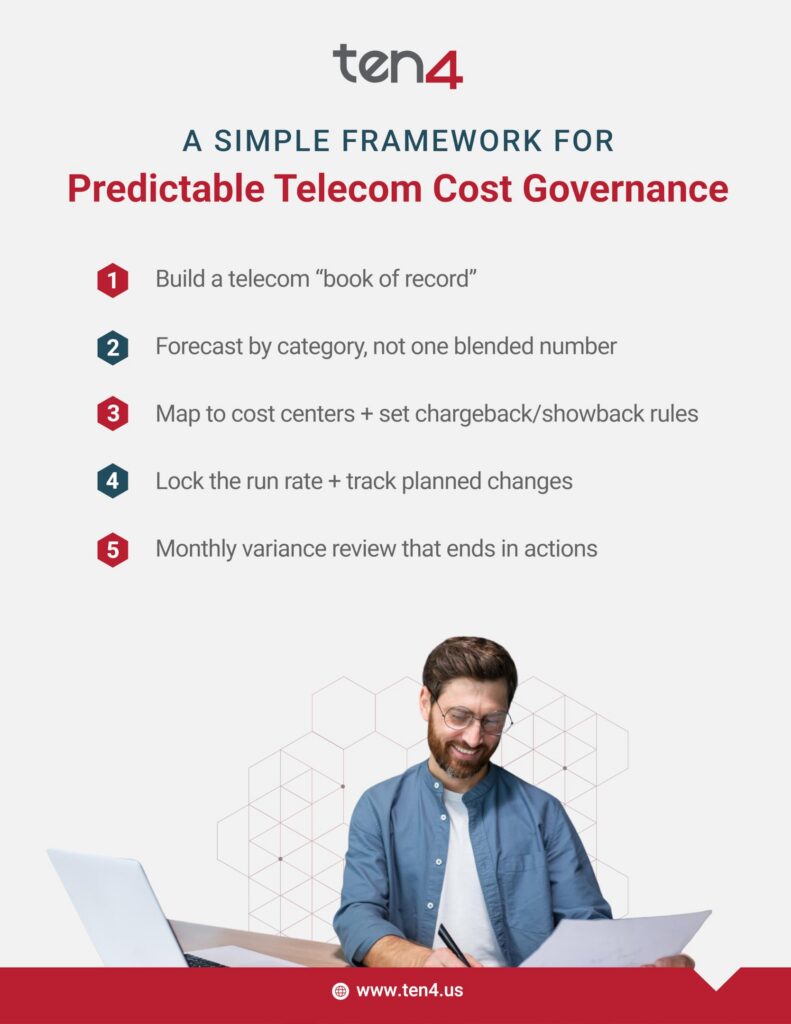
A simple framework for predictable telecom cost governance
You don’t need a year-long transformation to get control. Start with a scalable framework and knock them down one by one.
Step 1: Build a telecom “book of record”
Create one consolidated view of spend across carriers, locations, and services.
- Centralize invoices + contract data
- Normalize carrier/service naming
- Capture vendor, service type, site, cost center, and account number
Outcome: a monthly dataset Finance trusts and loves.
Step 2: Forecast by category, not one blended number
Break telecom into categories that behave differently and forecast each with the right drivers.
- Wireless
- Circuits/Internet
- Voice/UCaaS
- One-time charges
- Taxes/fees (track separately)
Outcome: variances clearly stand out and become explainable.
Step 3: Map to cost centers + set chargeback/showback rules
Keep it simple and consistent:
- Wireless → employee cost center
- Circuits → site cost center
- Shared services → defined allocation logic
- Exceptions → documented owner + review date
Outcome: ownership becomes real.
Step 4: Lock the run rate + track planned changes
- Run rate = recurring baseline by category/site/cost center
- Planned changes log = anything that will shift the baseline (adds/disconnects, installs, renewals)
Outcome: predictable forecasting.
Step 5: Monthly variance review that ends in actions
You can devote 30–45 minutes and focus on:
- Top variances
- Driver + owner
- One-time vs. recurring
- Next steps (disconnect, dispute, consolidate, renegotiate)
Outcome: forecasting improves every month, not just after renewals.

Looking for Better Telecom Expense Management Solutions? Start with Ten4
With telecom spend management backed by us at Ten4, forecasting gets steadier, and IT budget control gets a lot easier because what you’re spending is finally clear, organized, and governed.
Working with our telecom expense management software and support at Ten4, here is what teams get:
- A clean run rate to forecast from, so next month starts with reality, not a padded guess
- Faster variance answers by tying changes to simple drivers like price, scope, volume, or timing
- Cleaner cost center allocation to support chargeback or showback and reduce “who owns this?” chaos
- Less renewal and growth surprise because spending visibility and reporting make planning easier
If telecom forecasting still feels messy, it is usually a visibility problem, not a budgeting problem. Here at Ten4, we can help fix that with reporting and governance custom-built for multi-location enterprises.
Want to see how we can simplify your complexity (and benefit your bottom line)? Reach out to our team today!